Ostuni, the White City: A Complete Guide to History, Sea and Countryside
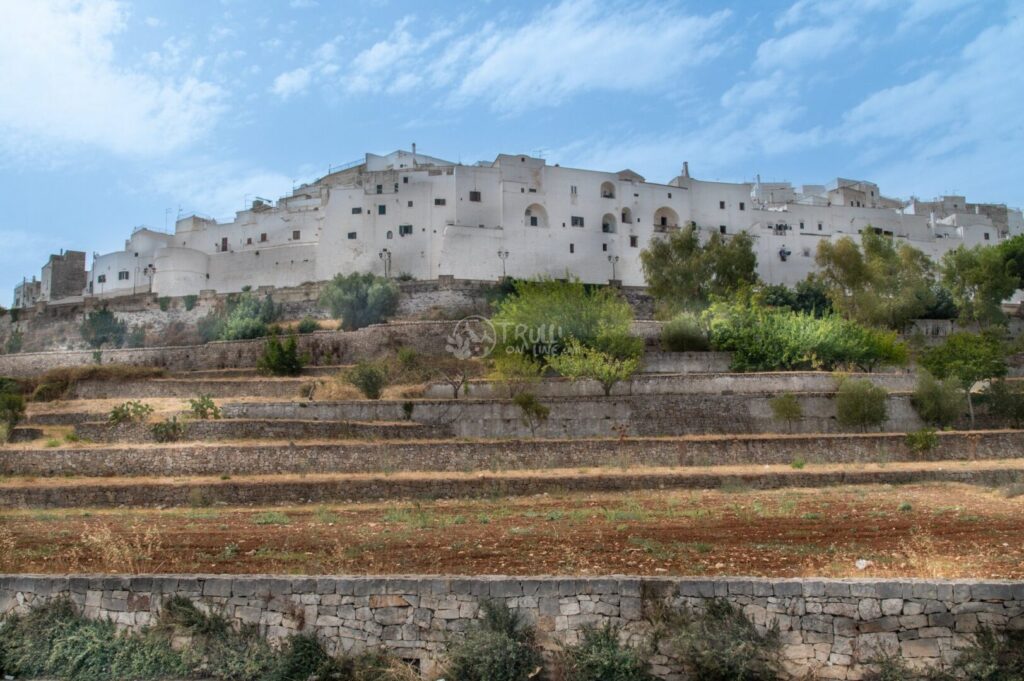
Seen from afar, Ostuni looks like a mirage. Spread across three hills, its lime-washed houses catch the sunlight and stand out against the silver-green of the olive groves, making the White City perhaps the most iconic image of Puglia. Arriving by car from the Itria Valley, you see it appear on the horizon like a luminous crown on the hilltop, a sight you will not forget.
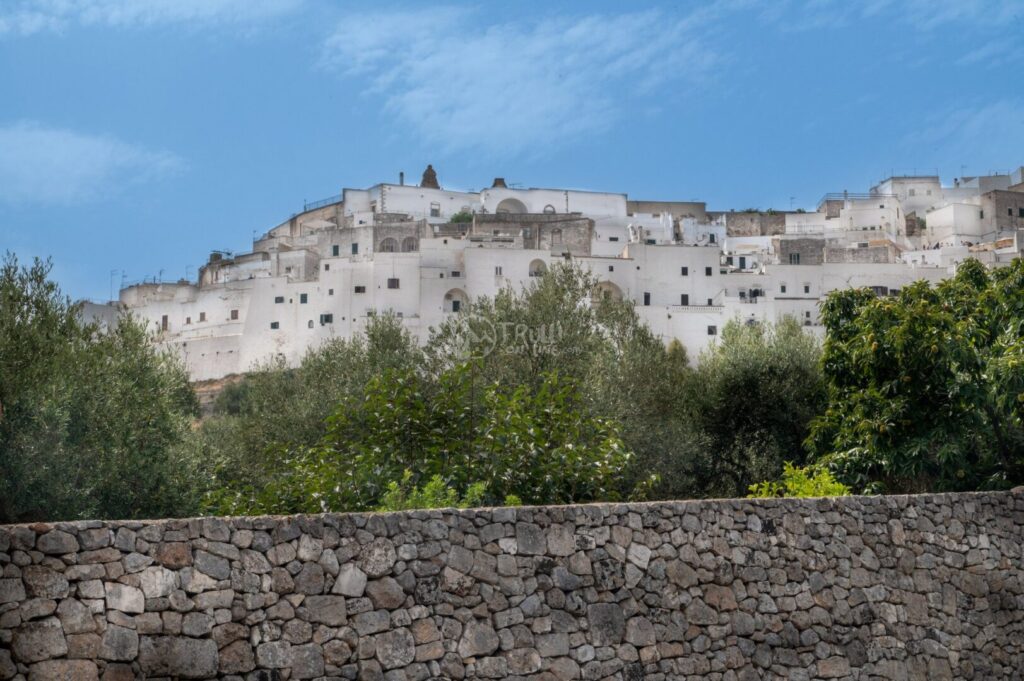
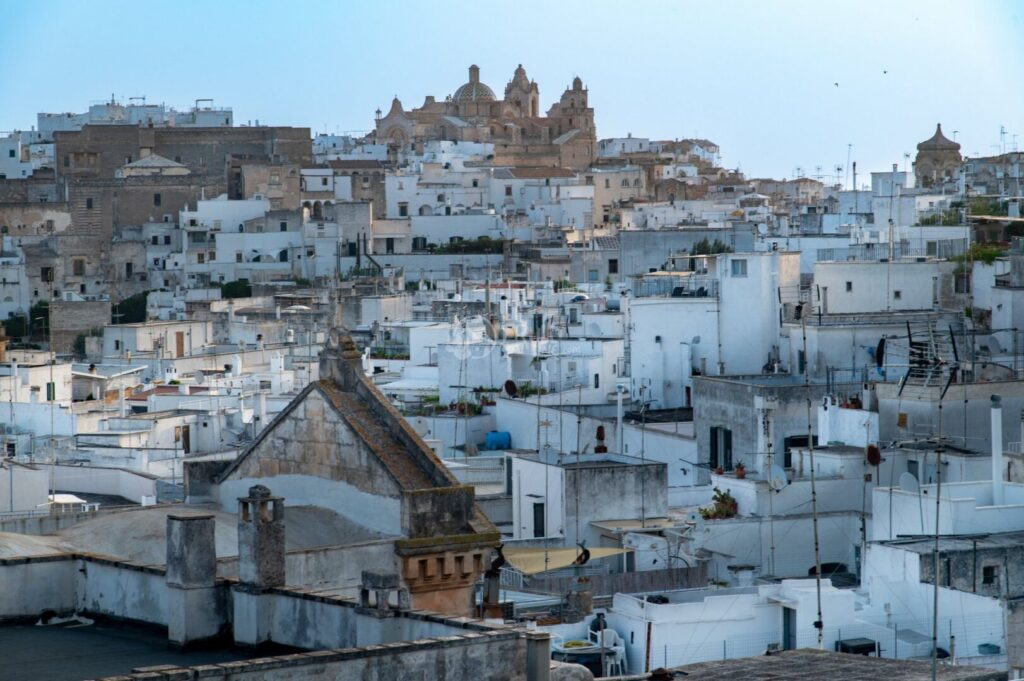
The medieval old town, known to locals as “la Terra”, is a dazzling maze of alleys, steps, arches and hidden courtyards that climbs to the fifteenth-century cathedral at the highest point of the city. Ostuni was Greek, Lombard, Norman, French and Aragonese, and every ruler left something behind within these walls. But Ostuni is not only its past: it is also a lively town, with an animated evening scene, a weekly market that is a local institution, and the beaches of the Adriatic coast less than ten kilometres away.
If you are staying in one of the trulli in the surrounding countryside, Ostuni is the natural base for grocery shopping, evenings out and days at the sea. Seven of our homes are in its territory, some just minutes from the centre, others closer to the coast.
What to see in the old town
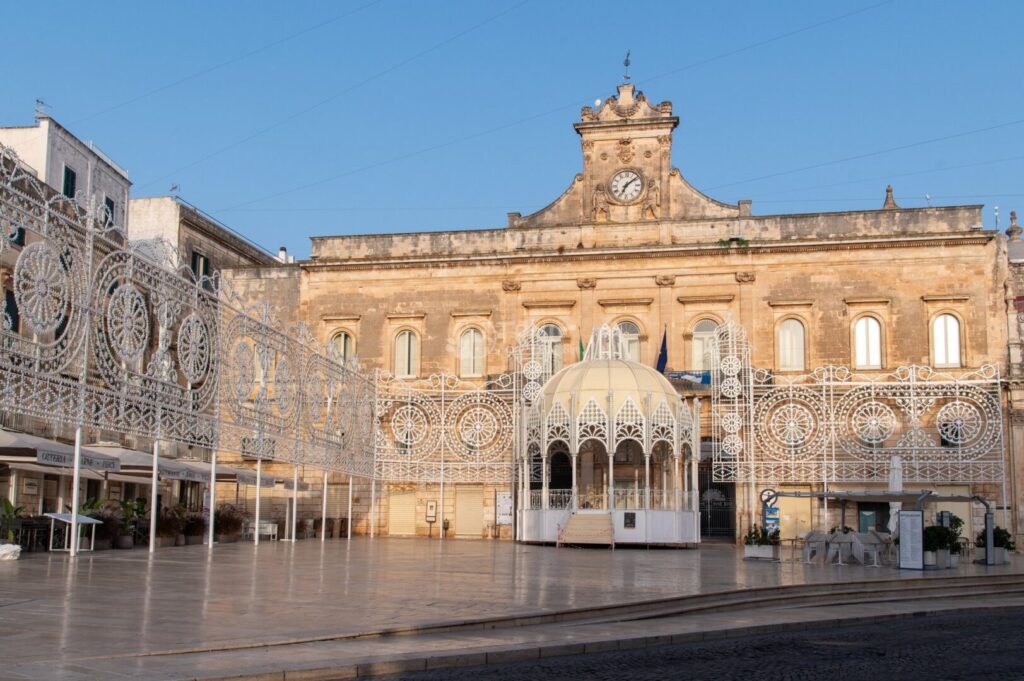
The natural starting point is Piazza della Libertà, the heart of the modern city, which links up with the ancient village. Here you will find the Column of Sant’Oronzo, the town’s patron saint, the Town Hall and the Church of San Francesco. From the square the climb to the old town proper begins, and the landscape changes at once: the lanes narrow, the white of the lime wraps around everything, and flowered balconies alternate with artisan workshops.
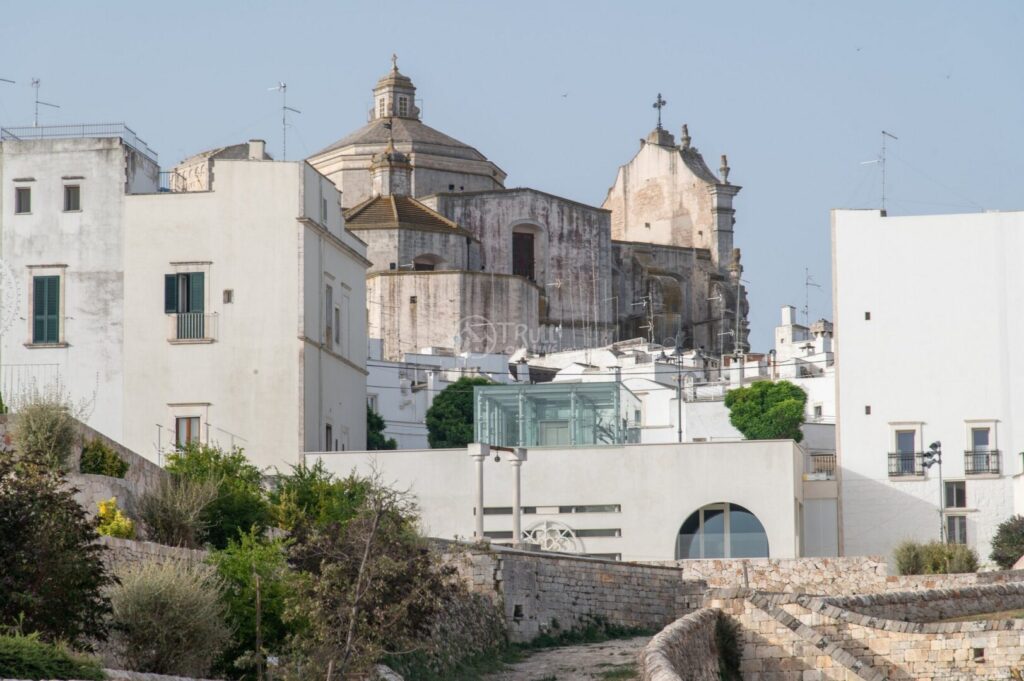
Walking up via Cattedrale, you pass beneath the Arco Scoppa, a raised passage connecting the Bishop’s Palace to the old Seminary, and arrive at the Co-Cathedral of Santa Maria Assunta. Built between 1435 and 1495, it is a rare example of Gothic in a region dominated by Romanesque and Baroque. The central rose window, with its 24 finely decorated rays, is one of the largest of its kind in Europe.
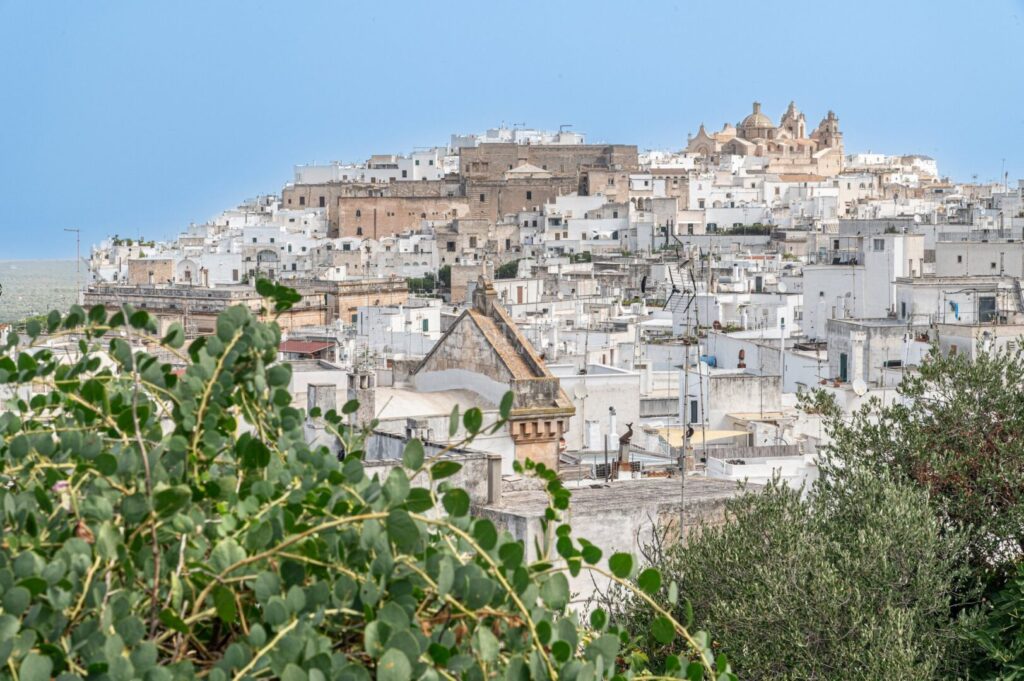
Continuing your walk beyond the cathedral, the lanes descend towards the oldest quarters of the town as far as the Angevin walls. Here tourism thins out and you can feel the everyday life of the village. For the best view of Ostuni from outside, the viewpoint on Corso Vittorio Emanuele II offers a frontal panorama of the old town on its hill, especially beautiful at sunset.
The Museum of Pre-Classical Civilisations of the Southern Murgia is also worth a visit, housed in the former convent of Santa Maria Maddalena dei Pazzi on via Cattedrale. Its best-known piece is the skeleton of the “Woman of Ostuni”, a young pregnant woman who lived about 25,000 years ago, found in the Agnano cave. Opening hours: from July to December every day 10:00-13:00 and 16:00-19:00; from January to June Monday to Friday mornings only, Saturday and Sunday also in the afternoon. Admission 5 euros, reduced 3 euros.
The Saturday market
Every Saturday morning, in the area of Via degli Emigranti near the Church of the Madonna del Pozzo, one of the loveliest weekly markets in Puglia comes to life. It is not a tourist market: it is where the people of Ostuni do their shopping, meet friends and have coffee at the bar. Stalls of zero-kilometre fruit and vegetables, fresh cheeses, taralli, olives and freshly pressed oil mix with areas devoted to clothing, shoes and bags, and a second-hand section with vintage clothes where you can find real bargains.
For guests staying in the trulli in the countryside, the Saturday market is the chance to stock up on local products and experience a moment of authentic Puglian life. It starts around eight in the morning and closes around one in the afternoon. Our advice is to get there early, when the stalls are still fresh and parking is easier to find.
Where to eat
Ostuni’s cuisine follows the Puglian tradition with its local variations: orecchiette with turnip tops, fava bean purée with chicory, raw Adriatic fish, focaccia, friselle with cherry tomatoes and oregano, black pepper taralli. The old town is full of small restaurants and osterie, many of them set in former stables and cellars with stone vaults.
For everyday shopping, besides the Saturday market, Ostuni has well-stocked supermarkets in the newer part of town. But for oil, wine and cheese it is worth seeking out local producers: the countryside around Ostuni is an endless olive grove and many farms sell directly. Extra virgin olive oil is the real gold of this land, and among the producers in the area is our own Humus Nature, the oil from the olive trees that surround our homes.
The beaches of Ostuni and surroundings
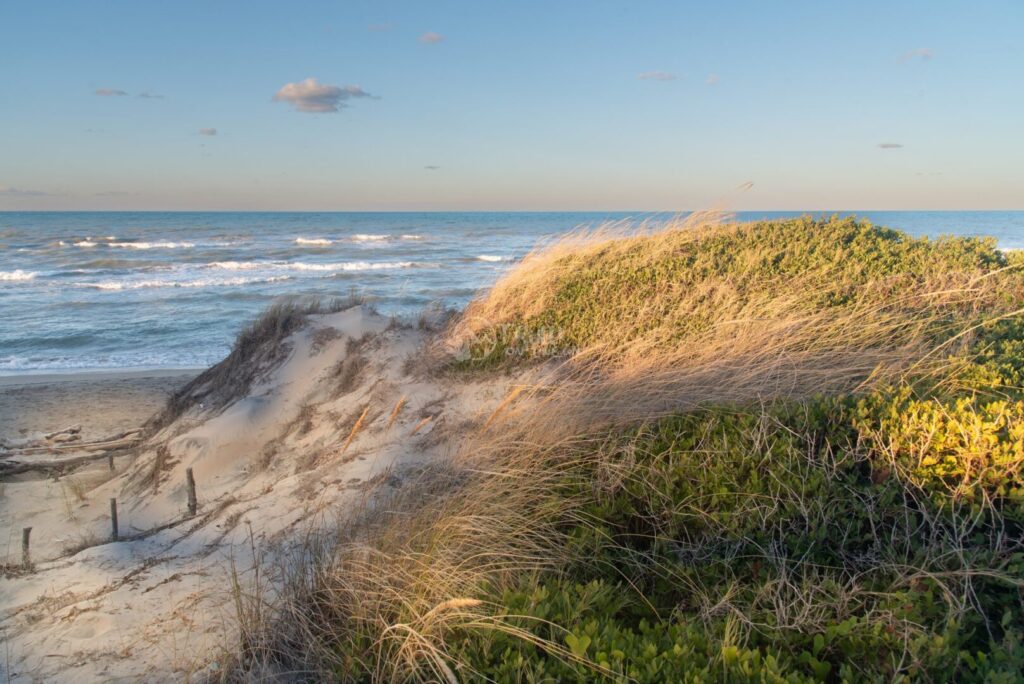
Unlike many villages in the Itria Valley, Ostuni has the sea close by. Its coastline stretches for almost twenty kilometres along the Adriatic, with sandy beaches and dunes that have earned the town the Blue Flag.
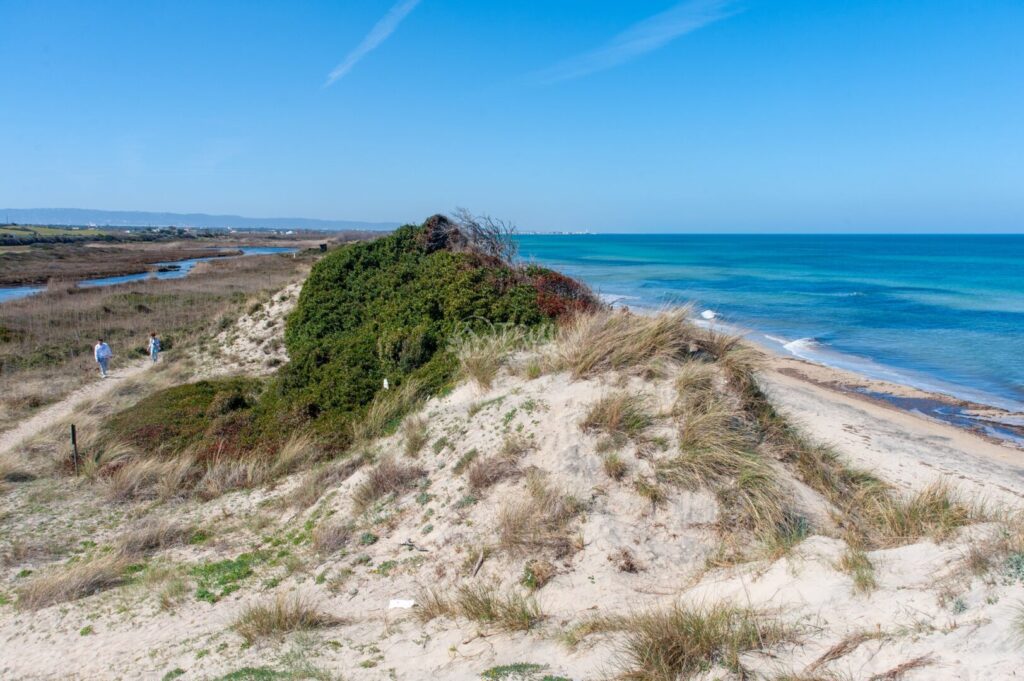
Torre Pozzelle and the Guaceto area offer the wildest and most protected stretch, right next to the Torre Guaceto Nature Reserve. Access to the reserve is regulated and in high season it is best to arrive early. Along the coast you will find equipped beach clubs such as Lido Morelli and Quarto di Monte, with umbrellas, sunbeds and all services, alternating with stretches of free beach with sandy dunes where you can lay down a towel and enjoy the sea in peace.
The distance from the centre of Ostuni to the coast is about 7-9 kilometres, roughly fifteen minutes by car. For guests staying in the trulli of the inland countryside, the distance varies: some of our properties, such as Trullo il Nespolo and Trullo Candido, are just a few kilometres from the sea.
Between Torre Canne and Torre San Leonardo, in the territories of Ostuni and Fasano, lies the Dune Costiere Regional Natural Park: sandy dunes, wetlands and centuries-old olive trees to be discovered on foot or by bike along paths suitable for everyone. Routes and details are in our guide to the Dune Costiere Park.
Nightlife
After sunset, Ostuni is probably the liveliest village in the Itria Valley. The old town fills with bars, wine bars, enotecas and small restaurants where you can dine outdoors among the white lanes. The area around Piazza della Libertà and the adjacent streets is the meeting point for an aperitivo, while the upper old town offers a more intimate, quiet atmosphere.
In summer the calendar of events becomes busier: concerts in the square, art exhibitions in historic palaces, evening markets. The great festival is the Cavalcata di Sant’Oronzo, on 24, 25 and 26 August: a procession with caparisoned horses, spectacular festive lights and fireworks that draws visitors from across the region.
How to get there and where to park
Ostuni is about 35 kilometres from Brindisi airport (just under half an hour by car) and about 85 kilometres from Bari airport (a little over an hour). The town also has a railway station on the Trenitalia Bari-Lecce line, handy if you want to take a trip without a car, although from the station to the old town it is a bit of a climb.
As for parking, the old town is a restricted traffic zone (ZTL). The best options are the municipal car park beneath the walls on via Giosuè Pinto (paid in summer, free in winter) and the car park between via Pisanelli and via Specchia in the modern part of town. On summer weekend evenings spaces fill up quickly: arriving before 7 pm is a good rule.
Where to stay in Ostuni: our trulli
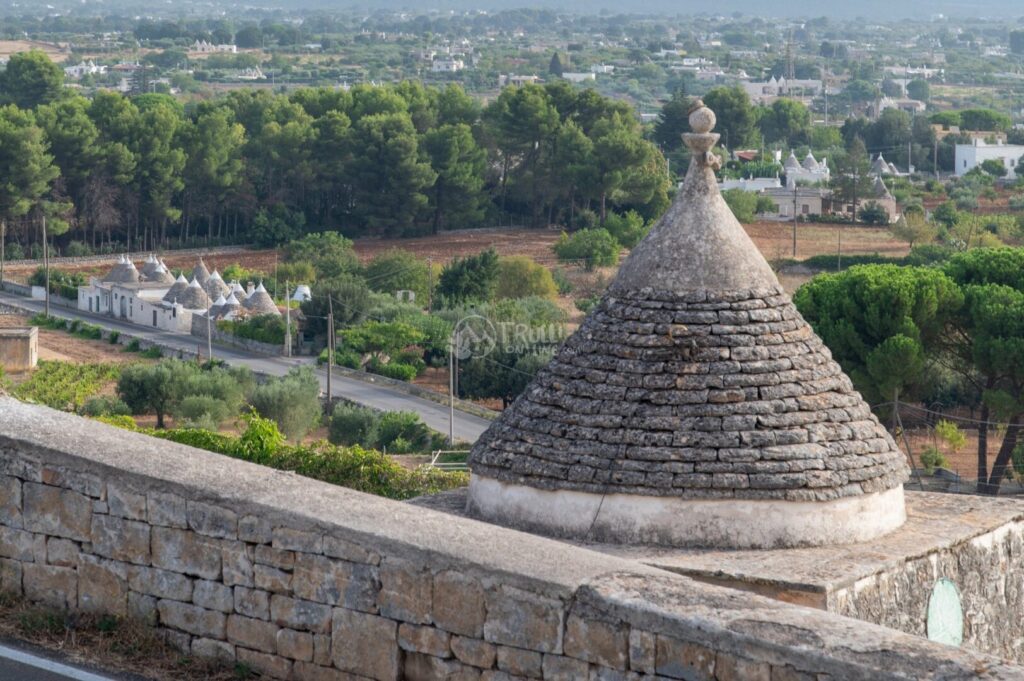
The territory of Ostuni is vast and our seven homes are spread across different locations: some in the hilly inland with views over the valley, others very close to the coast. The choice depends on what you are looking for: the quiet of the countryside and closeness to the old town, or the convenience of having the sea a few minutes away.
Close to the sea
Trullo Candido is the property closest to the coast: just two kilometres from the sea, with a private pool, ideal for a couple who want to alternate countryside and beach without long transfers. Up to four guests.
Trullo il Nespolo is in contrada Tamborroni, halfway between the White City and the sea: six kilometres from the coast, six from the centre. Welcoming and spacious, it comfortably hosts a couple or a family with children, up to six people.
Casa di Chicca e Titti is only eight kilometres from the sea and three from the centre of Ostuni. Suitable for families of four to seven guests.
Inland
Trullo ad Ostuni is a nineteenth-century home with two original cones and a lamia, carefully restored, five kilometres from the centre. The porch surrounded by olive trees is perfect for outdoor dinners. Up to four guests.
Trulloleandro, six kilometres from the centre, is immersed in the countryside and welcomes up to six people. Casa Madamì lies further inland, four and a half kilometres from the village, for those seeking complete tranquillity. Up to six guests.
For large groups
Trulli Due Mari is the largest property in the Ostuni area: up to ten guests, five bedrooms each with private bathroom, pool, sauna, outdoor kitchen, yoga room and winter garden. It is set in the countryside between Ostuni and Ceglie Messapica. The separate living units (independent trulli and lamie) work as separate suites, which makes it ideal for groups of friends or extended families who want to live together while keeping their privacy.
Ostuni and the Itria Valley
Ostuni is the eastern gateway to the Itria Valley and the most convenient base for combining the sea with exploring the villages of the interior. Cisternino with its fornelli is twenty minutes away, Alberobello with its UNESCO World Heritage trulli half an hour, Martina Franca with its Baroque architecture and music festival twenty-five minutes. Ceglie Messapica, the gastronomic capital of the valley, is a quarter of an hour away.